Premise
A single control is a single point of failure. The question worth asking about any hardening measure is not “does this help?” but “what still gets through when this one fails?”
This build layers six independent controls across a RHEL instance on EC2, deliberately arranged so that defeating one does not grant access.
The layers
IAM least privilege. The root account is used for infrastructure creation and nothing else. Day-to-day operations run under scoped roles, so a compromised operational credential cannot restructure the account.
Security Groups. Explicit allow-listing at the AWS network boundary, with an Elastic IP giving a stable, controlled entry point.
firewalld on the host. A default-deny host firewall that does not depend on the cloud provider’s controls being correct. If a security group is misconfigured — the single most common cloud mistake — the instance still refuses the traffic.
SSH lockdown. Key-based authentication only, password authentication disabled, root login disabled. This removes credential guessing as an attack path entirely rather than trying to survive it.
fail2ban. Automated banning after repeated failures. With password auth already off this is defence in depth rather than the primary control — it absorbs the noise and reduces log volume from opportunistic scanning.
CloudWatch monitoring. Agent-based metrics and dashboards, so the controls above produce visible evidence rather than silent assumptions.
Applied state
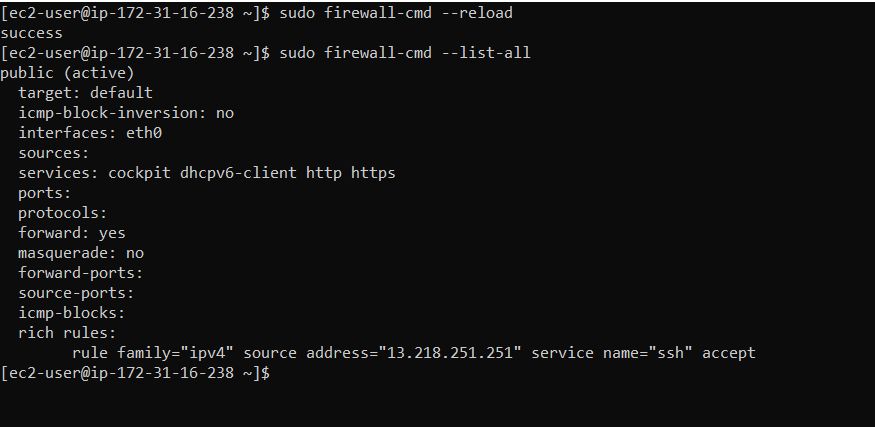
firewall-cmd --list-all. Default zone active, and a rich rule narrowing SSH to one source address rather than the whole internet.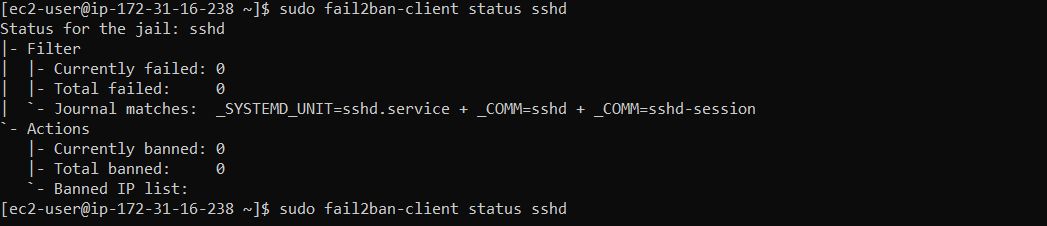
sshd jail active. Zero bans here because password authentication is already disabled; fail2ban is depth, not the primary control.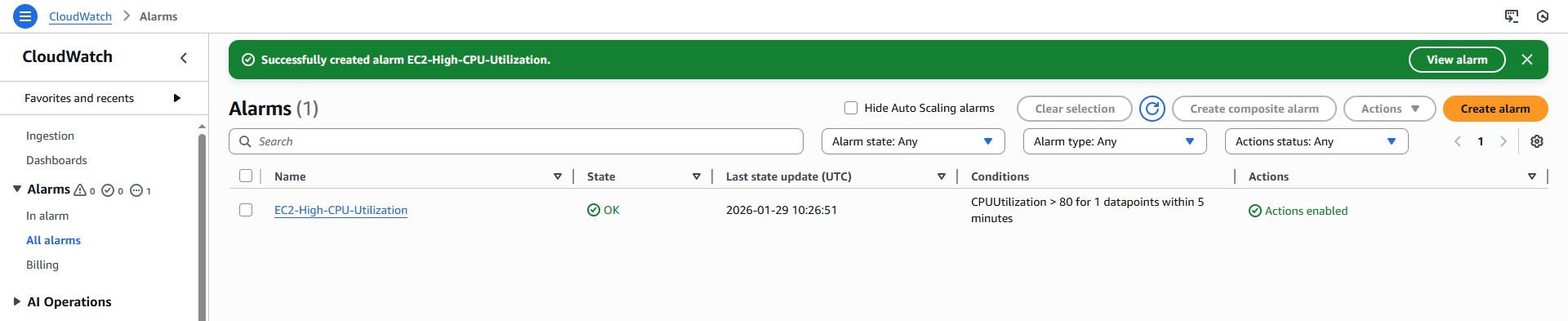
The part that matters
All of it is applied by automation. Ansible playbooks and Python orchestration mean the baseline is a reproducible artifact, not a sequence of remembered commands. The same run applies to one node or several hundred, and two nodes provisioned the same way are provably identical.
Hardening applied by hand is not a baseline — it is a story about what someone did once. Hardening applied by code can be re-run, diffed, and proved.
Honest limitations
No benchmark measurement. The controls are sound but they were chosen by reasoning rather than scored against a published standard. Running the CIS Benchmark for RHEL through OpenSCAP would turn “hardened” into a number with a before and after — which is what an auditor or a client actually wants to see. That is the obvious next iteration.
No drift detection. The playbook establishes the baseline; nothing verifies it is still in place a month later.
Ingress only. Like most hardening work, this constrains what reaches the host and says nothing about what the host can reach outbound — which is where a compromise becomes an exfiltration.